

Using Payable on Death (POD) Accounts in North Carolina
A payable on death (POD) account lets an account owner name a beneficiary to receive the money remaining in a bank account after death while the owner keeps control during life. POD accounts can be a simple estate planning tool because they generally allow funds to pass outside ordinary probate. They should still be coordinated with your will, trust, and other beneficiary designations.
At The Doyle Law Offices, our estate planning lawyers have supported Wake County families in need of wills, trusts, beneficiary planning, and other estate planning services since 1995.
Table of Contents
What Is a Payable on Death (POD) Account?

A payable on death account is a deposit account with a named beneficiary who receives the funds after the account holder's death.
The account holder controls the account while alive. The POD beneficiary generally has no ownership interest or access during that time. Under North Carolina law, the owner may also change the beneficiary through written direction to the financial institution.
Depending on the bank, eligible accounts may include checking accounts, a savings account, money market accounts, and certificates of deposit.
What Are the Benefits of a POD Account?
For a straightforward bank account, a POD account can make it easier to transfer remaining funds to a beneficiary after the account owner dies. It can also reduce some of the court involvement, paperwork, and delays that may come with estate administration.
What a Power of Attorney Give You Authority Over
North Carolina’s Uniform Power of Attorney Act identifies several categories of authority that a principal may grant.
A POD Account Can Avoid Probate
A properly established POD account will usually pass directly to the named beneficiary rather than through the probate process. That can reduce probate-related costs and delays for those particular funds.
POD Designations Are Simple to Set Up
Many banks allow an account owner to add a POD beneficiary by completing a designation form, often without opening a new account. There is no separate court filing or estate planning document required to create the designation, although individual bank policies may vary.
The Account Owner Keeps Control While Alive
Naming a POD beneficiary does not give that person access to the money while the account owner is alive. The owner keeps full control of the account and can make deposits, withdraw funds, close the account, or change or remove the beneficiary.
POD Accounts Don't Have a Minimum Balance Requirement
A POD designation itself does not require an account owner to maintain a separate minimum balance. The account remains subject to the bank’s regular balance, fee, and account requirements.
Beneficiaries May Gain Faster Access to Funds
Because POD funds transfer outside ordinary estate administration, the beneficiary may be able to gain access sooner than if the money had to remain in the estate through probate. The financial institution will usually require proof of death and identification before releasing the funds.
What Are the Disadvantages of a POD Account?
A POD account can be useful, but its simplicity may create problems when an estate involves debts, a trust, or multiple beneficiaries.
- Limited distribution control: A POD account transfers funds directly to the beneficiary without detailed instructions on how or when the money should be used.
- Possible conflicts with an estate plan: A POD designation can create unequal results or confusion if it does not match the account owner’s will or trust.
- No protection during incapacity: If the owner becomes incapacitated, the POD beneficiary does not automatically gain access to the account.
- Issues with multiple beneficiaries: Naming several beneficiaries can raise questions about percentage shares or what happens if one person dies first.
- Estate debts and costs may still apply: POD funds are not automatically protected from valid claims, and the estate may still need money for debts, taxes, or other costs.
How Do You Set Up a POD Account?
You usually do not need to open a new account to create a payable on death arrangement. An existing eligible account can be updated through your bank or other financial institution.
- Contact your bank: Ask whether the account is eligible for a POD designation.
- Request the POD form: The financial institution will typically provide its own beneficiary designation form.
- Designate your beneficiary: Name one or more beneficiaries and provide percentage splits if the bank requires them.
- Submit the form: Return the completed paperwork according to the bank’s instructions.
- Request written confirmation: Keep documentation showing the POD designation with your estate planning records.
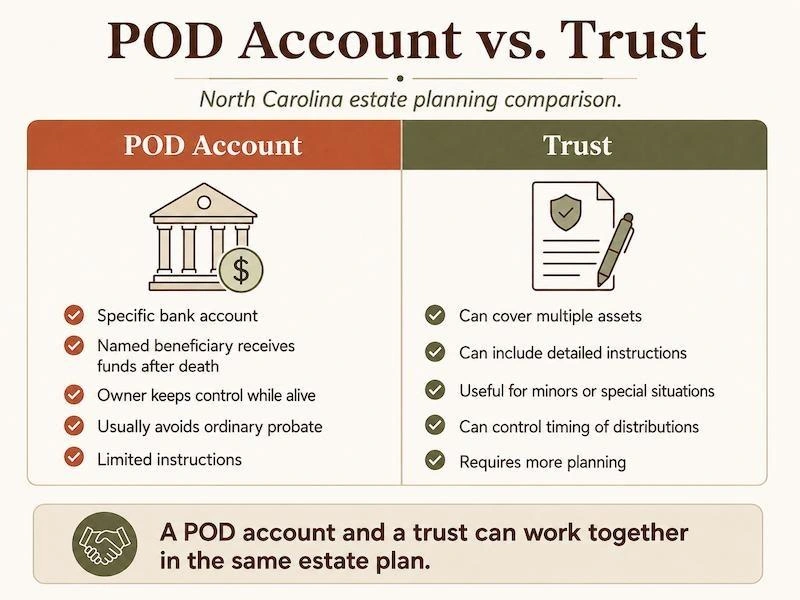
POD Account vs Trust: What Is the Difference?
A POD account applies to a specific bank or deposit account, whereas a trust covers several types of assets and includes detailed instructions about how and when beneficiaries receive property.
Common POD Account Mistakes to Avoid
POD accounts are relatively simple to create, but beneficiary designations can cause problems when they remain unchanged for years or are not coordinated with the rest of an estate plan.
Payable on Death (POD) Account FAQs
Is a payable on death account a good strategy?
A payable on death account can be a good strategy for someone who wants a simple way to transfer a bank account outside ordinary probate. It may not be enough by itself when an estate involves minor children, a blended family, creditor concerns, or more complicated assets.
Consider scheduling a consultation with The Doyle Law Offices to discuss whether or not a POD account is a good idea for your estate planning strategy.
Can a POD beneficiary access the account while the owner is alive?
No, a POD beneficiary cannot access the account simply because they are named as beneficiary. The account owner keeps control during life, and the beneficiary’s rights begin after the death of the last surviving account owner.
What happens if the POD beneficiary dies before the account holder?
If a POD beneficiary dies before the account holder, the result depends on the account structure and whether another beneficiary is named. Without a surviving beneficiary, the funds may become part of the owner’s estate.
Does a POD account override a will?
Yes, a POD account will usually override a will for that specific account. The bank follows the beneficiary designation on file rather than conflicting instructions stated within the will.
POD accounts can be a low-cost way to transfer bank funds, but the designation should fit the rest of your estate plan. At The Doyle Law Offices, Attorney Hank Doyle has been helping families in Wake Forest and Cary create and update estate plans since 1995.
To discuss whether a payable on death account or other beneficiary designation fits your plans, call (984) 235-1067 or fill out the form below to schedule a consultation.
Schedule a Consultation
"*" indicates required fields
This article is written for North Carolina families and is for general information only. It is not intended as legal advice for your particular situation.